Digital marketing for tour operators: how to get more tour bookings
By the Eco Biznfc team · Updated 21 November 2026 · 9 min read
The short answer
Tour operators get more bookings by doing four things in order: make the website easy to book on a phone, run Facebook and Instagram lead ads to the travellers who buy your kind of trip, reply to every enquiry within minutes, and keep a Google Business Profile with recent reviews. For one tour company we work with, this brought 1,000+ leads at under AUD 4.50 each and more than AUD 200,000 in bookings.
This guide is for owners of tour, charter and activity businesses who want more direct bookings without handing a commission to a marketplace on every seat. It uses real figures from tour companies we work with in Australia, and it applies just as well to operators in New Zealand and the United States.
Step 1: Make your website easy to book on a phone
Ads and SEO only bring people to your site. The site has to do the rest. Open your own website on your phone and check that a stranger can do these things without calling you:
- See what the tour is, with real photos, how long it takes and what's included.
- See the dates and the price. Hidden prices make people leave to compare elsewhere.
- Book or enquire in a couple of taps. A booking system such as Rezdy or FareHarbor on your own site, or at least a short enquiry form.
- Trust you. Recent reviews, how long you've been running, and a real person's name.
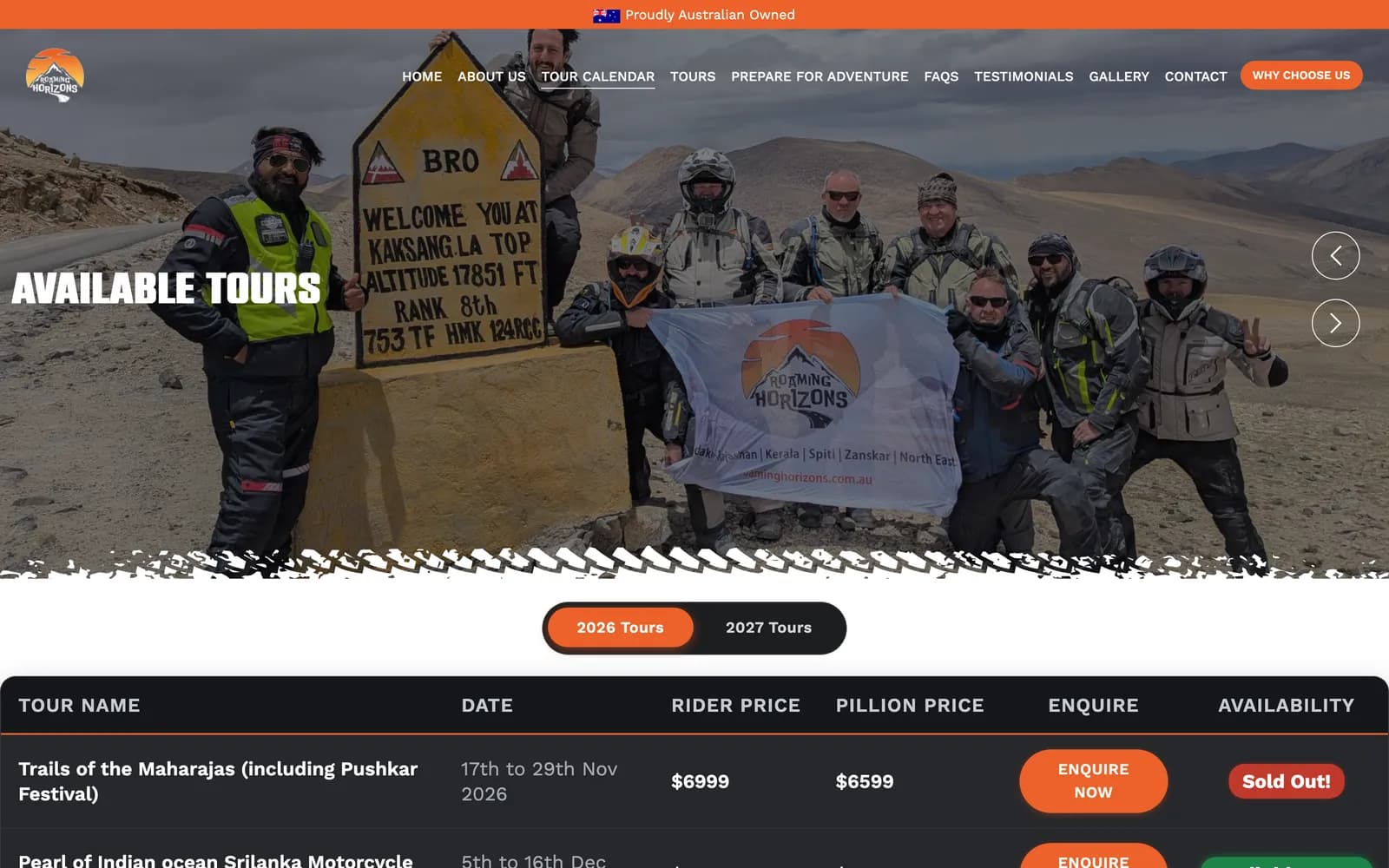
Also check the small things that make a site look abandoned: an old copyright year, a notice from a past season, or a “Book now” button that only opens a contact page. For Roaming Horizons we built a tour calendar that lists upcoming departures, so riders can see what's coming and enquire about a specific trip. See our tour operator website design page for more examples.
Step 2: Know what a booking is worth
Before spending on ads, work out two numbers: what one booking earns you, and roughly how many enquiries it takes to get one. If a booking is worth AUD 3,000 and one in ten enquiries books, each enquiry is worth about AUD 300 to you. That tells you what you can afford to pay per lead, and it stops you judging ads only by how cheap the clicks are.
Step 3: Run Facebook and Instagram lead ads
Most people don't search for a tour they've never heard of. Meta ads put your trip in front of people who fit your typical guest, and a lead form collects their name and contact details without leaving the app. This works especially well for trips people plan ahead: multi-day tours, international group trips and special-interest travel.
- Aim at the people who actually book. Roaming Horizons runs international motorcycle tours mostly for Australian riders aged 45 to 75, so the campaigns were built for that group.
- One clear offer per ad. A named tour, a departure date or season, and one action: get the itinerary, or ask about dates.
- Keep the form short. Name, email and phone are usually enough. You can ask the rest when you reply.
What it really costs: figures from our clients
| Tour company | Leads | Cost per lead | Bookings |
|---|---|---|---|
| Roaming Horizons (NSW, motorcycle tours) | 1,000+ in the first 2.5 months | Under AUD 4.50 | AUD 200,000+ |
| Roaming Horizons, one 5-week window (1 July to 6 August 2026) | 338 | $5.28 average | Not split out |
| RAP Safaris (India tiger safaris for Australian travellers) | 6 of the first 10 booked | Under AUD 6 | About AUD 12,000 in the first month |
Figures are from each client's Meta Ads Manager and bookings, as shown in the Roaming Horizons and RAP Safaris case studies. Your costs will differ with your tour, price and audience.
Step 4: Use your own footage
Tour businesses already have what most advertisers lack: real footage of people having a good time. Short vertical videos of guests on tour, cut to 15 to 20 seconds with the destination and date on screen, usually beat polished stock footage. Guest testimonials filmed on a phone work well too. You can see examples on our ad work page.
Step 5: Reply fast, then keep in touch
A lead is most interested in the first few minutes. Set things up so nobody waits for you to check your inbox:
- Send an instant reply by email or text with the itinerary and a way to book or call.
- Put every lead in one place. A CRM such as GoHighLevel shows who enquired, about which tour, and who still needs a call.
- Email them while they decide. Big trips take weeks to decide on. For Roaming Horizons, Brevo email campaigns sent from their own domain keep leads engaged while they plan their ride.
Step 6: Be found on Google
- Google Business Profile. Claim it, add photos, tours and opening season, and ask every guest for a review. This is what shows for “near me” and map searches.
- A page for each tour and destination. One page per tour, with the name people search for in the title, answers Google and gives ads somewhere good to land.
- Google search ads for people already looking for a tour like yours in your area.
Step 7: Get ready for ChatGPT and AI search
More travellers now plan trips by asking ChatGPT, Gemini or Google's AI answers. These tools quote clear facts, so write them down plainly on your site: dates, price, duration, group size, fitness level, what's included and what isn't. Add a questions section to each tour page. You can also advertise inside ChatGPT. We ran ChatGPT ads alongside Meta and Google for the launch of VOYŌ, a sailing superyacht on the Gold Coast.
Step 8: Track where each booking comes from
You can only spend more on what works if you know what works. Tag every link, connect your booking system to Google Analytics, and record the source of each booking: Meta, Google, a marketplace, or a direct visit. For VOYŌ, bookings go through Rezdy and travel marketplaces, and the site tracks the source of each one.
Marketplaces or direct bookings?
Marketplaces such as Viator and GetYourGuide bring travellers you wouldn't reach alone, and they take a commission on each booking. Direct bookings from your own site and ads keep that margin and give you the guest's contact details for next season. Most operators do best with both: marketplaces for reach, and their own marketing for margin and repeat guests.
Quick checklist
- Check your site on a phone: tour, dates, price and booking visible without a call.
- Work out what a booking and an enquiry are worth to you.
- Run one Meta lead campaign for one tour, with your own footage.
- Reply to every lead within minutes, and email them while they decide.
- Claim your Google Business Profile and ask every guest for a review.
- Write clear facts and questions on each tour page for Google and AI search.
- Record the source of every booking.
Questions
How do tour operators get more bookings?+
Make it easy to book on a phone, then bring the right travellers to the site and follow up fast. In practice: a website that shows dates and prices and takes bookings, Facebook and Instagram lead ads, a reply to every enquiry within minutes, and a Google Business Profile with recent reviews.
How much do Facebook ads cost for tour operators?+
You choose the ad budget, and the cost per lead depends on your tour and audience. As real examples from our clients, Roaming Horizons paid under AUD 4.50 per lead across its first 1,000+ leads, and RAP Safaris paid under AUD 6 per lead.
Should a tour operator use Facebook ads or Google ads?+
Both do different jobs. Facebook and Instagram ads reach people who would love your tour but aren't searching for it yet, which suits trips people dream about and plan ahead. Google ads reach people already searching for a tour like yours in your area. Many operators start with one, then add the other.
Do I need a new website before running ads?+
Not always. If travellers can see the tour, dates and price on a phone and can book or enquire easily, you can start ads now. If they can't, fix that first, because ads will only send more people to a page that doesn't convert.
How long does it take to see results?+
Lead ads on Meta usually bring enquiries within the first weeks. Roaming Horizons had more than 1,000 leads in its first two and a half months. SEO takes longer, usually months, which is why most operators run ads while their search rankings build.
How can a tour operator show up in ChatGPT and Google's AI answers?+
Give AI tools clear facts to quote: a page for each tour with plain answers about dates, price, duration, group size and what's included, FAQ sections, structured data, and reviews on Google and other sites that mention your tours by name.
Want us to look at your tours?
We'll review your website and ads for free and tell you what we'd change first. Calls on Australian, New Zealand and US hours.
See tour operator marketing